

Mathematics
National Curriculum Guidance
“Mathematics is a creative and highly inter-connected discipline that has been developed over centuries, providing the solution to some of history’s most intriguing problems. It is essential to everyday life, critical to science, technology and engineering, and necessary for financial literacy and most forms of employment. A high-quality mathematics education therefore provides a foundation for understanding the world, the ability to reason mathematically, an appreciation of the beauty and power of mathematics, and a sense of enjoyment and curiosity about the subject.”
Our Intent
Our intent is that the teaching of maths will:

Be at the core of what we do and enables our children to flourish in order to become independent, confident, healthy and responsible members of society, as well as developing the “whole child” intellectually, morally, socially and spiritually.

All pupils will experience Forest School. Forest school promotes the holistic development of pupils, fostering resilience, confidence, independence and creativity in the outdoor world as the children learn about the natural world and how to look after it. Forest School also promotes environmental awareness.

Teach knowledge and skills as well as values of citizenships in order to keep themselves healthy and safe as they prepare for growing up, life and work in Modern Britain and the global community.

Weaving through the heart of our PSHE teaching, is a commitment to enhancing and promoting our core Christian Values.

Allow children leave St Oswald’s, with the knowledge, understanding and emotions to be able to play an active, positive and successful role in today’s diverse society. To give them the confidence to tackle many of the moral, social and cultural issues that are part of growing up
Our Implementation
The key areas of implementation we use are:
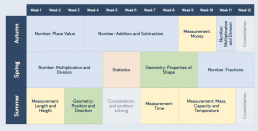
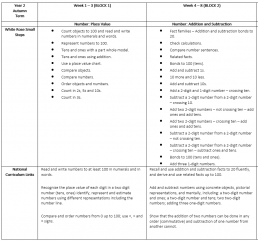
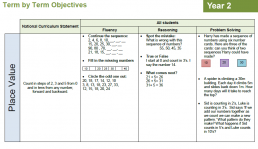
Our primary planning tool and long term plan is based upon the White Rose Maths scheme of work. These plans are designed to support a mastery approach to teaching and learning and have been designed to support the aims and objectives of the National Curriculum.
Planning documents-example (Year 2)
Mathematics is an interconnected subject in which pupils need to be able to move fluently between representations of mathematical ideas. The programmes of study are, by necessity, organised into apparently distinct domains, but pupils should make rich connections across mathematical ideas to develop fluency, mathematical reasoning and competence in solving increasingly sophisticated problems. They should also apply their mathematical knowledge to science and other subjects.
The expectation is that the majority of pupils will move through the programmes of study at broadly the same pace. However, decisions about when to progress should always be based on the security of pupils’ understanding and their readiness to progress to the next stage. Pupils who grasp concepts rapidly should be challenged through being offered rich and sophisticated problems before any acceleration through new content. Those who are not sufficiently fluent with earlier material should consolidate their understanding, including through additional practice, before moving on.
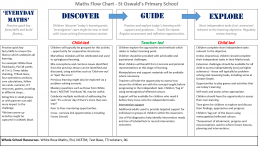
Flow Chart
The flow chart serves as an overview of how the subject is taught to ensure consistency in the following areas:
- Lesson structure
- Assessment
- Learning environment
- Resources
- Metacognitive scaffolding including knowledge organisers
- How we enhance the curriculum e.g. visits, celebrations, theme weeks
Impact
At St Oswald’s we see our children flourish through the wide-ranging curriculum to provide them with. We strive for the whole curriculum to be exciting, engaging and for all children to feel a sense of success. In Maths, we aim for the impact to be:
- Children achieve highly in maths. All key stages score above the national average.
- Children follow a clear structure of lessons, which gives them a consistent approach to learning.
- Children reflect on their learning, helping them to see their own successes and areas for development.
- Through assessment, children receive weekly wave 2 teaching sessions where consolidation and improved understanding is required.